The Growth of No-Code & Low-Code Platforms in 2026
Introduction
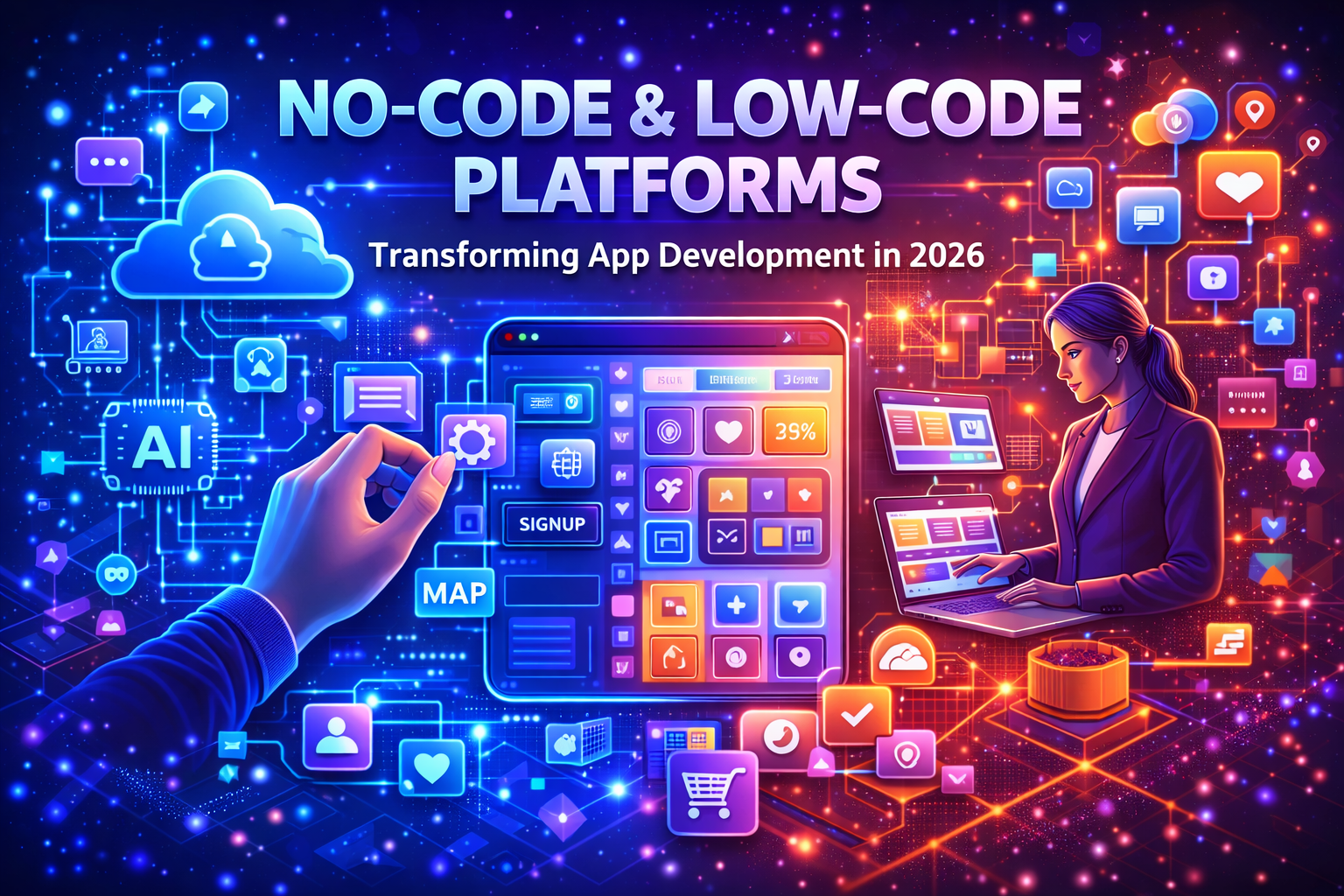
The innovation scene is advancing at lightning speed, and computer program advancement is no exemption. Customarily, building applications required proficient coding aptitudes and long improvement cycles. In any case, no-code and low-code stages are changing this paradigm. No-Code & Low-Code Platforms
By 2026, these stages are anticipated to change the way businesses and people make program, decreasing costs, expanding speed, and democratizing app development.
But what are no-code and low-code stages, and why is their development accelerating?

What Are No-Code & Low-Code Platforms?
No-Code Stages: Permit clients to construct applications without composing a single line of code. Clients drag and drop prebuilt components to make apps. Cases incorporate Bubble and Adalo.
Low-Code Stages: Require negligible coding and are planned to speed up improvement for both proficient engineers and non-technical clients. Illustrations incorporate OutSystems and Mendix.
Key Contrast: No-code is pointed at non-technical clients, whereas low-code is for engineers looking for speedier workflows.
Why No-Code & Low-Code Are Developing in 2026
1️⃣ Quick Advanced Transformation
Businesses are beneath weight to dispatch program quicker to stay competitive. No-code and low-code stages permit for quick prototyping, diminishing advancement time from months to days.
2️⃣ Democratization of App Development
Anyone, from trade examiners to business people, can make utilitarian apps without contracting a full improvement group. This opens openings for development over industries.
3️⃣ Taken a toll Efficiency
Hiring talented designers is costly. Utilizing these stages, organizations can cut improvement costs altogether, whereas still making high-quality software.
4️⃣ Integration with Developing Technologies
Modern no-code and low-code stages coordinated consistently with AI, IoT, cloud administrations, and computerization apparatuses, empowering more progressed applications than ever before.

Real-World Applications
Startups: Rapidly construct MVPs (Least Practical Items) to test advertise ideas.
Enterprises: Computerize inner workflows, dashboards, and announcing tools.
E-commerce: Make custom apps for stock administration, client engagement, and dependability programs.
Healthcare: Construct apps for understanding following, arrangement planning, and telemedicine platforms.
Benefits of No-Code & Low-Code Platforms
Faster advancement cycles
Reduced dependence on specialized developers
Easier upkeep and updates
No-Code & Low-Code Platforms
Encourages development and experimentation
Enables little groups to compete with huge companies
Challenges and Limitations
Limited customization compared to conventional coding
Security and compliance concerns for enterprise-level applications
Performance limitations for profoundly complex applications
Vendor lock-in: moving apps to other stages can be difficult
The Future Outlook
By 2026, no-code and low-code stages are anticipated to:
Drive more extensive selection of AI-powered automation
Become standard devices in endeavor IT and startups
Enable citizen designers to make imaginative apps without formal coding skills
Facilitate cross-industry computerized transformation
Experts foresee that these stages will decrease the demand-supply hole for computer program engineers whereas enabling businesses to enhance speedier.
Outbound Links
1️⃣ Bubble – No-Code App Builder
2️⃣ Adalo – No-Code Mobile Apps
Share this content:














Post Comment