How AI Is Transforming Education and the Workplace in 2026
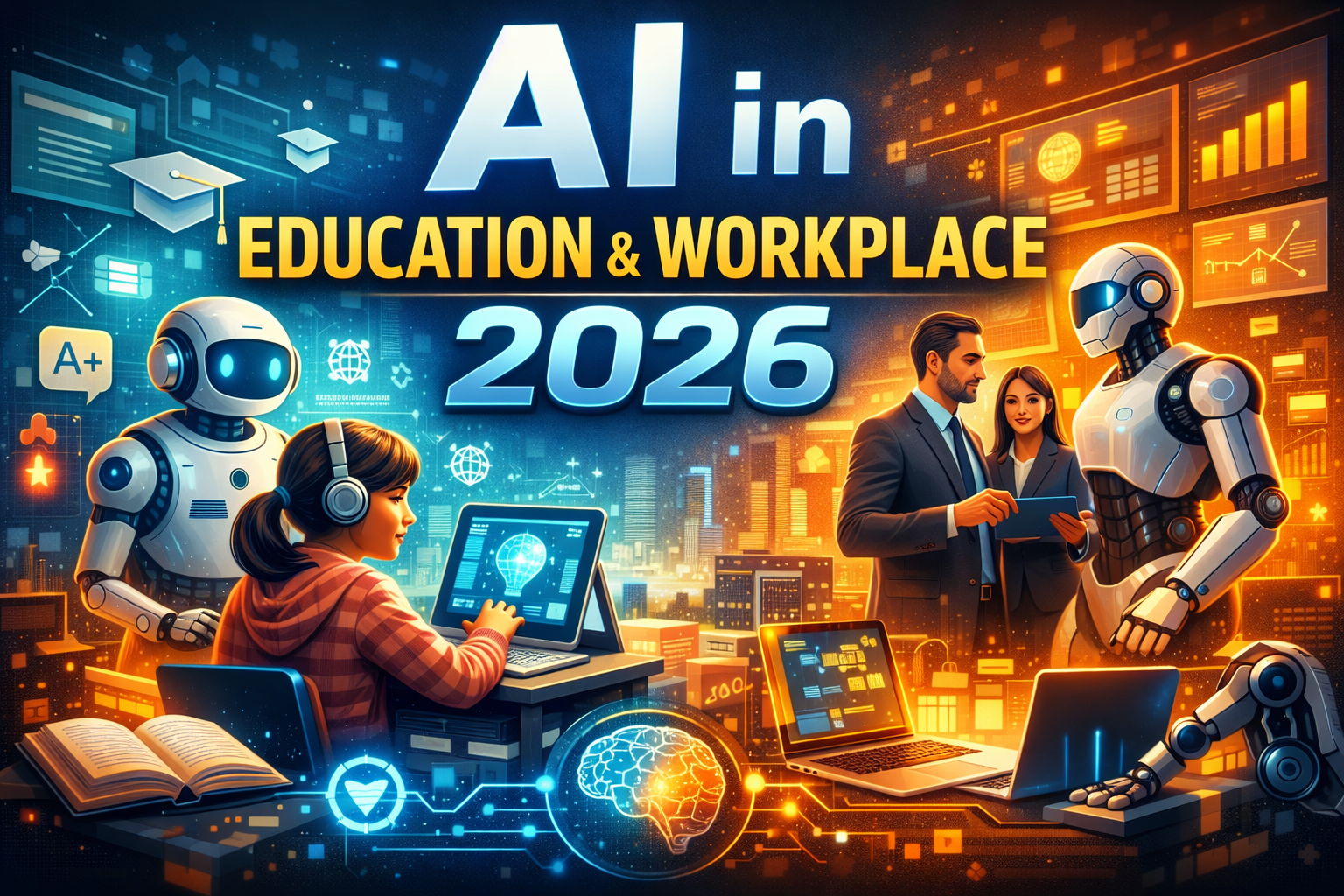
Introduction

Artificial intelligence (AI) is no longer just a futuristic concept—it has become an integral part of our daily lives. From the apps we use to manage schedules to virtual assistants helping with tasks, AI is quietly shaping the way we learn and work. In 2026, its impact is more profound than ever, creating opportunities for efficiency, personalization, and innovation in both education and the workplace.
AI’s ability to analyze massive amounts of data, predict outcomes, and automate repetitive tasks allows students and professionals to focus on creativity, problem-solving, and strategic thinking. This article explores how AI is transforming education, revolutionizing work, and reshaping the skills and tools we need to thrive in the modern world.AI in Education and Workplace 2026
AI in Education:

Personalizing the Learning Experience
Education has historically followed a “one-size-fits-all” model, where students of diverse abilities and learning speeds are expected to keep up with the same curriculum. AI is changing this by enabling personalized learning, tailoring lessons to each student’s strengths, weaknesses, and learning pace.
Virtual Tutors and AI Teaching Assistants
AI-powered tutors can provide instant feedback, clarify complex topics, and offer additional practice in areas where students struggle. For example, a student learning algebra may receive extra practice on concepts they find difficult while advancing faster in areas they already understand. AI teaching assistants can even answer questions 24/7, providing support beyond the traditional classroom hours.
https://www.unesco.org/en/artificial-intelligence/education
Adaptive Learning Platforms
Platforms like these track a student’s progress, identify learning gaps, and adjust content automatically. This ensures that students receive exactly what they need at the right time. For instance, language learning apps can detect pronunciation errors and suggest corrective exercises tailored to the individual.

Collaboration and Accessibility
AI enhances collaboration by summarizing lectures, translating content in real-time, and recommending discussion topics for group projects. Furthermore, AI makes education more inclusive. Students with disabilities benefit from features like speech-to-text, real-time captioning, and adaptive learning tools that cater to various needs. This not only levels the playing field but also encourages participation from all learners.
https://www.forbes.com/education
Benefits in Higher Education
In universities and colleges, AI can assist professors in grading, analyzing student performance, and creating dynamic course content. Students can access virtual simulations, AI-driven research assistants, and personalized study plans that maximize learning efficiency. This creates a more interactive, engaging, and effective learning environment.
AI in the Workplace: Redefining Productivity
Just as AI transforms education, it is also reshaping how we work. Businesses are increasingly relying on AI to streamline operations, make data-driven decisions, and enhance collaboration among employees.
Task Automation and Efficiency
AI automates repetitive and time-consuming tasks such as data entry, report generation, and scheduling. By offloading these tasks to AI, employees can focus on higher-value activities like strategy, innovation, and problem-solving. For instance, an AI system can scan thousands of emails and prioritize them, saving employees hours every week.
Smart Collaboration Tools
AI-powered virtual meeting assistants transcribe meetings, highlight key points, and schedule follow-ups automatically. AI tools can also manage team workflows, track project progress, and recommend improvements, ensuring smoother collaboration in both remote and in-office environments.
Decision-Making and Analytics
In the modern workplace, data drives decisions. AI can analyze vast datasets far faster than humans, identifying patterns and insights that guide business strategy. Companies can use AI to predict market trends, assess customer preferences, and optimize operations, improving both efficiency and profitability
Remote Work Enablement
With the rise of remote and hybrid work models, AI tools facilitate seamless communication and collaboration. Virtual whiteboards, AI-driven project management platforms, and predictive workflow tools help remote teams stay productive, aligned, and connected, regardless of location.
Skills for the AI-Driven World
As AI reshapes education and work, it also changes the skills needed to succeed. Digital literacy, critical thinking, and creativity are now as essential as traditional academic knowledge. Students and employees must learn to collaborate with AI tools, analyze AI-generated insights, and use technology to solve problems rather than simply perform tasks manually.
Lifelong Learning
With AI continuously evolving, the need for ongoing learning has never been greater. Professionals must adapt to new tools, stay updated with emerging technologies, and embrace continuous upskilling to remain competitive. Similarly, students must be prepared to work alongside AI systems, understanding both their capabilities and limitations.
Challenges and Considerations
Despite its many benefits, AI also brings challenges. Privacy, ethical use, and data security are critical concerns in both education and work. Institutions and organizations must ensure that AI tools are transparent, unbiased, and used responsibly. Additionally, there is a need to prevent overreliance on AI; human judgment, creativity, and empathy remain irreplaceable.
The Future of AI in Education and Work
Looking ahead, AI will continue to integrate more deeply into our learning and work environments. In education, we may see fully AI-driven classrooms, adaptive virtual campuses, and predictive tools that anticipate student needs. In the workplace, AI could manage complex logistics, offer advanced project planning, and provide insights that enable faster, smarter decision-making.
The convergence of AI with other emerging technologies like augmented reality (AR), virtual reality (VR), and the Internet of Things (IoT) will create more immersive, interactive, and efficient experiences. The future promises a world where technology not only assists humans but actively empowers them to achieve more.
Conclusion
Artificial intelligence is transforming both education and the workplace in 2026. By personalizing learning, automating repetitive tasks, and enhancing collaboration, AI allows students and professionals to focus on creativity, innovation, and problem-solving. While challenges remain, embracing AI responsibly can lead to smarter, more efficient, and inclusive environments for learning and work.
The AI-driven world is not a distant future—it is here today, and those who understand and leverage its potential will thrive in the years to come.
Outbound Links:
- AI in Education Overview:
https://www.edutopia.org/article/artificial-intelligence-education - AI in the Workplace:
https://www.forbes.com/sites/forbestechcouncil/2023/05/16/how-artificial-intelligence-is-transforming-workplaces/ - AI-Powered Learning Tools:
https://www.pearson.com/uk/educators/ai-in-education.html - AI and Productivity:
https://hbr.org/2022/07/the-promise-of-ai-in-the-workplace - Future of AI in Society:
https://www.weforum.org/agenda/2023/01/ai-future-work-education/
Share this content:














Post Comment