What’s Really Changing? write a article
Introduction
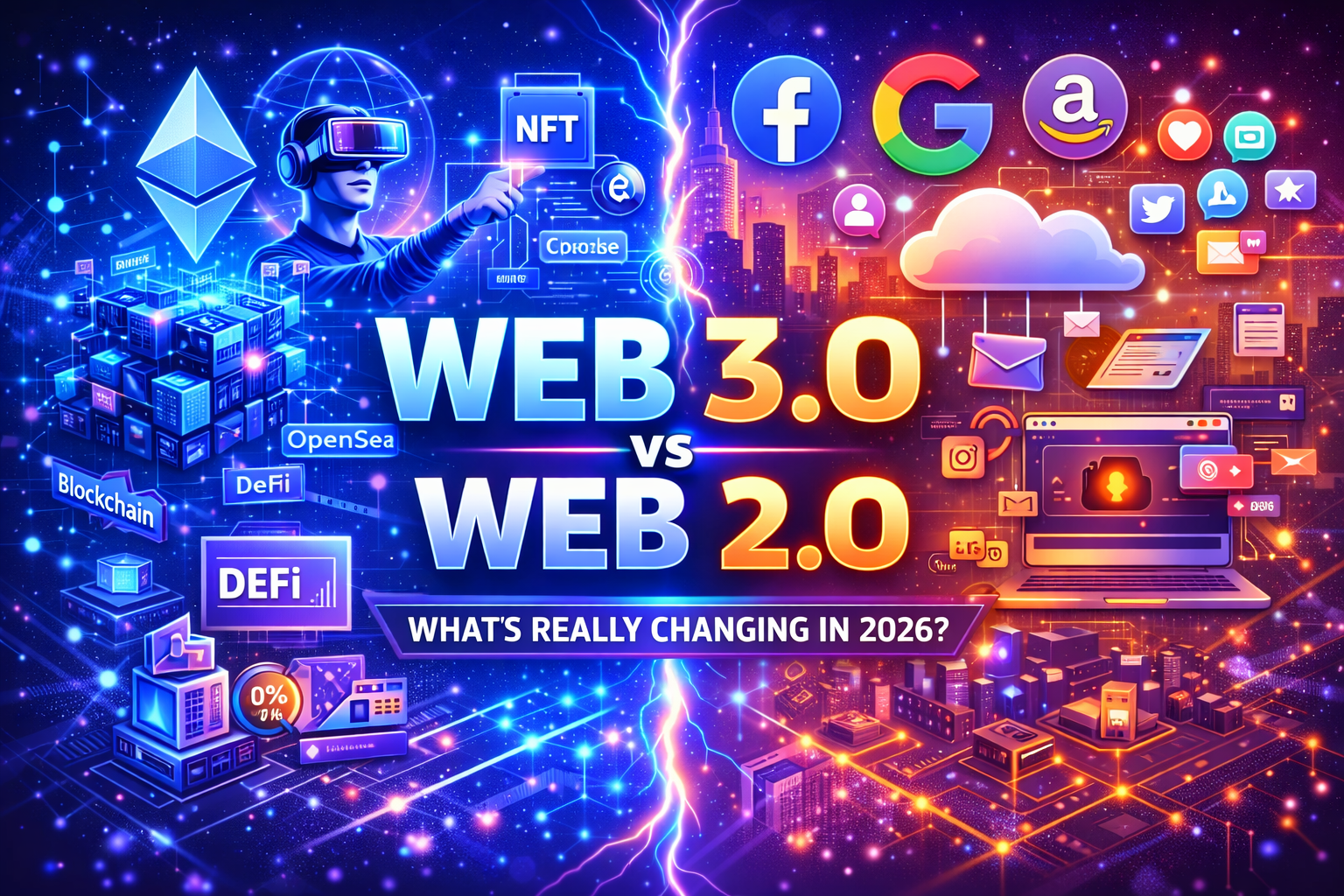
The web has advanced quickly over the past two decades. From the inactive websites of the early 2000s to the intelligently stages we utilize nowadays, the move from Web 1.0 to Web 2.0 changed the way we communicate, devour, and make content. Web 3.0 vs Web 2.0
Now, a modern transformation is on the skyline: Web 3.0. This following era of the web guarantees decentralization, security, and client control like never some time recently. But what truly separates Web 3.0 from Web 2.0, and why ought to we care? Let’s explore.

What Is Web 2.0?
Web 2.0 is the form of the web we generally utilize today:
Interactive websites and social media stages (Facebook, Twitter, Instagram)
User-generated substance and collaborative stages (YouTube, Wikipedia, blogs)
Centralized administrations controlled by huge companies (Google, Amazon, Meta)
Key Highlights of Web 2.0
Interactivity: Clients can comment, like, share, and transfer content. Web 3.0 vs Web 2.0
Centralization: Information is put away and overseen by companies.
Advertising-Driven Models: Most stages create income through advertisements and data.
Web 2.0 has changed the way we communicate and do commerce, but it has moreover raised concerns over security, information control, and monopolistic practices.

What Is Web 3.0?
Web 3.0 is the following era of the web, frequently called the “Semantic Web” or “Decentralized Web.” Its center thought is to provide control back to clients instep of centralized corporations.
Key Highlights of Web 3.0
Decentralization: Information is conveyed over blockchain systems instep of centralized servers.
Ownership: Clients can really possess their computerized resources (NFTs, cryptocurrency, individual data).
Artificial Insights: More astute calculations give personalized experiences. Web 3.0 vs Web 2.0
Interoperability: Stages and applications can consistently connected over networks.
Popular illustrations incorporate blockchain stages like Ethereum, NFT marketplaces, decentralized fund (DeFi) apps, and rising metaverse worlds.
Web 3.0 vs Web 2.0: Fundamental Differences
Feature Web 2.0 Web 3.0
Data Storage Centralized servers Decentralized blockchain
Control Corporations (Meta, Google) Users themselves
Monetization Ads, corporate revenue Tokenization, NFTs, De Fi
Privacy Limited, tracked Enhanced, user-controlled
Interoperability Limited High, cross-platform
Example Platforms Facebook, YouTube, Instagram Ethereum, Open Sea
How Web 3.0 Is Changing the Internet .Web 3.0 vs Web 2.0
User Empowerment
Users control their information, character, and advanced resources. Stages compensate substance makers straightforwardly through tokens and crypto.
Decentralized Fund (DeFi)
Web 3.0 empowers money related administrations without banks. Clients can loan, borrow, and contribute universally utilizing blockchain.
The Metaverse & Virtual Worlds
Users can connected in virtual 3D spaces, claim advanced arrive, and exchange resources seamlessly.
Privacy & Security Improvements
Data is scrambled and disseminated, lessening the hazard of hacks and centralized information misuse.
New Trade Models
Web 3.0 permits new companies to work without mediators, advertising peer-to-peer administrations, decentralized apps (dApps), and NFT-driven economies.
Challenges of Web 3.0
Complexity: Clients require to get it wallets, blockchain, and tokens.
Regulation: Governments are still figuring out how to direct decentralized networks.
Scalability: Blockchain systems can be slower than conventional centralized systems.
Adoption: Far reaching utilize will take time due to learning bends and framework needs.
The Future Outlook
By 2026, Web 3.0 seem reshape:
Social media, giving clients genuine possession of content
Online gaming, through NFTs and computerized economies
Finance, through decentralized and borderless platforms
Digital personality, protection, and security
It speaks to a move from an web possessed by organizations to one claimed by clients, emphasizing straightforwardness, security, and interest.
Outbound Links for Web 3.0 Article
- Ethereum Official Website (Blockchain Platform)
https://ethereum.org/en/ - OpenSea – NFT Marketplace
https://opensea.io/ - Gartner – Web 3.0 Insights
https://www.gartner.com/en/insights/web-3-0
Share this content:









Post Comment